
Blog
How to break down taboos about menstrual health
Menstrual health is an aspect that, in certain contexts, remains taboo. We will explain why this is the case in a specific community: Chheda Nagar.
As you know, Chheda Nagar is one of the communities where we at Mumbai Smiles have been working since long time. As an unauthorized settlement, it frequently suffers from evictions and the demolition of shacks. It is situated along the edge of a highway. The community consists of families who have migrated from various regions of India, particularly from Nagpur. The majority belong to the Matang and Vadari castes, which are considered among the lowest within India’s caste system.
One of the most frequent problems in a community with these characteristics is that related to sanitation and hygiene. The dwellings are situated in close proximity to landfills or sewers. Moreover, these are precarious dwellings—extremely small and constructed from sheets of plastic or metal. Often, multiple families inhabit a single dwelling and share the same space, leading to overcrowding and a complete lack of privacy.
Unhygienic conditions
There are spaces resembling communal latrines, constructed from plastic sheets, but they are unhygienic. There is no running water system. The cleaning and waste collection—tasks assigned to the men of the community—are inadequate. The reality is that waste accumulates between the dwellings and in the alleys, where children run and play—most of the time barefoot.
In this context, hygiene and health conditions among women and girls become an issue requiring close attention, as diseases and infections are frequently detected that could be easily prevented through minimal guidelines and habits.
Menstrual Health session
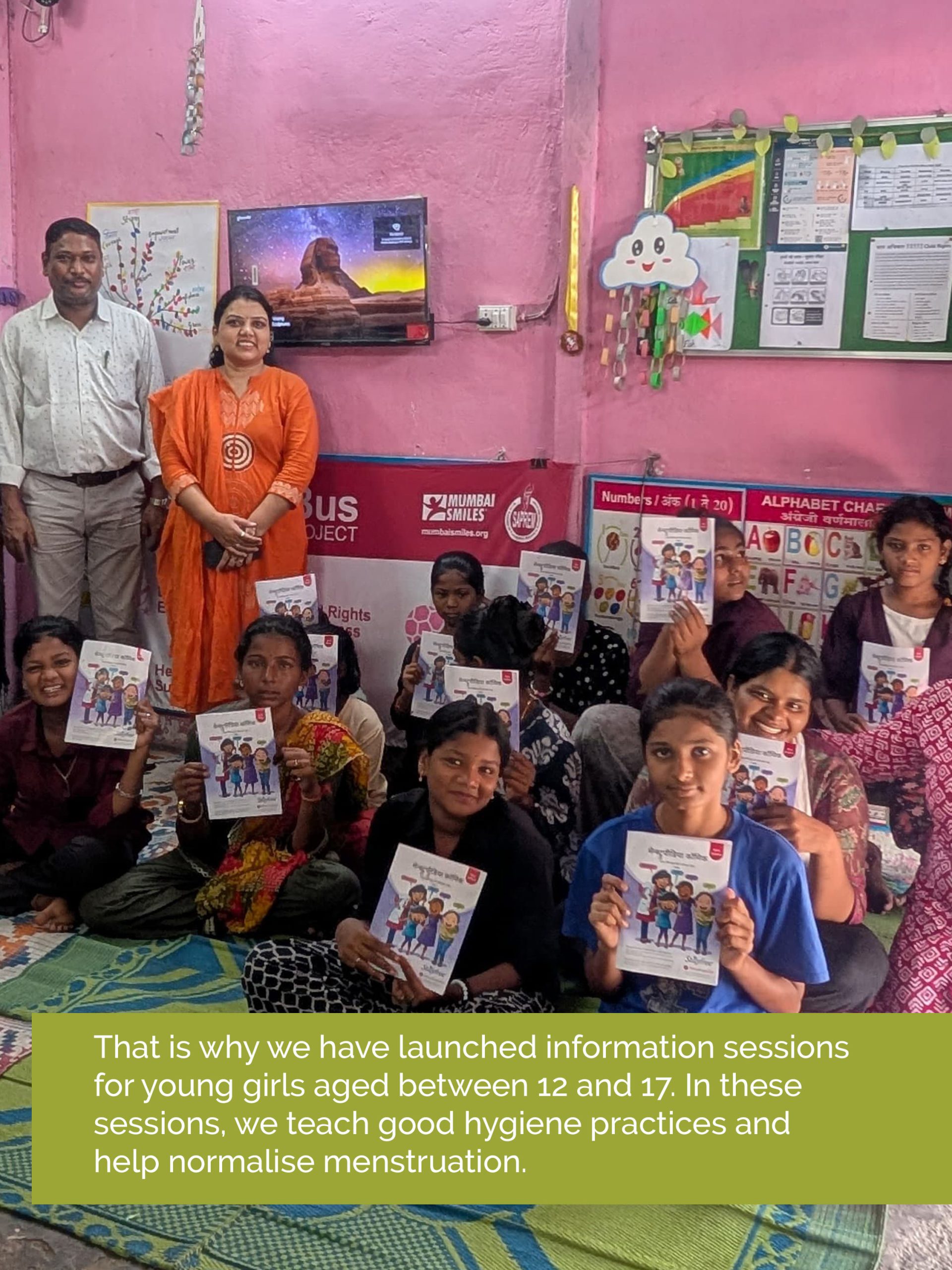
For this reason, we have launched a series of information sessions for girls aged 12 to 18 who are beneficiaries of the Smiling Bus and Library on Wheels projects. It is these young women who have the greatest need for information, as menstrual health remains a taboo subject for them. Things such as speaking openly about menstruation with their families or friends—or going to a pharmacy to purchase intimate hygiene products—are uncomfortable situations and discussing the topic is generally frowned upon.
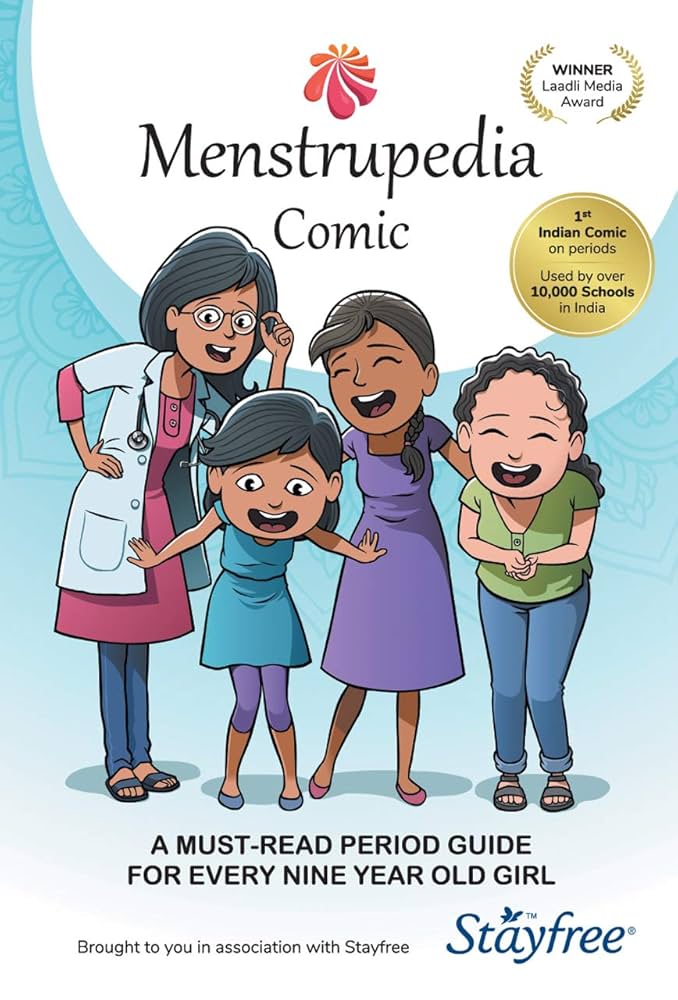
Brochure in the comic format which we distributed amongst young beneficiaries to inform about the menstrual heath.
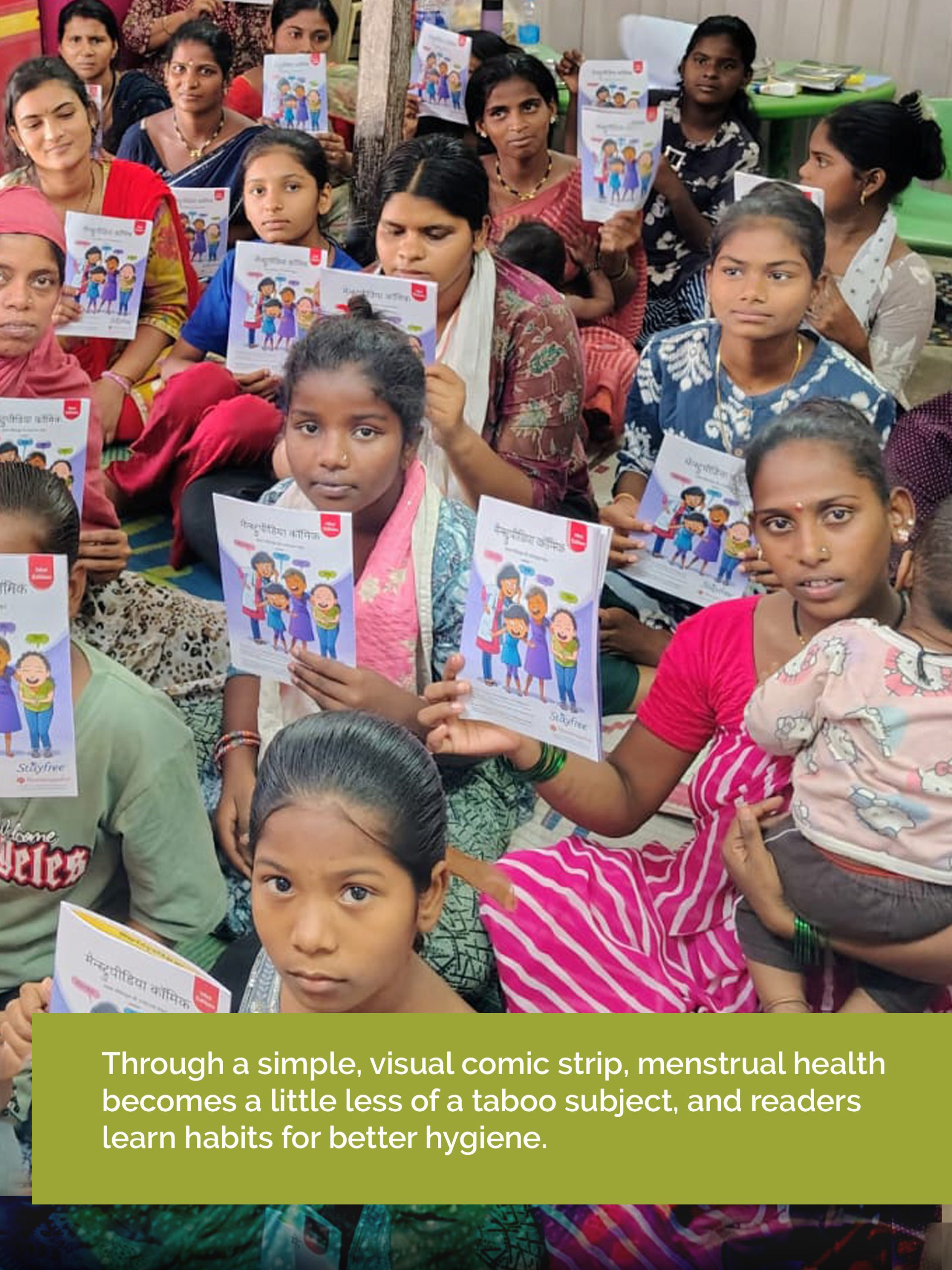
In collaboration with the Pagaria Foundation and a group of students from the Tata Institute of Social Sciences(TISS), we have launched a series of informational sessions for the girls of Chheda Nagar. Using a comic book and various supporting audiovisual materials, we explain what menstruation entails—its characteristics and the effects it has on women. Above all, we highlight the recommended practices and habits for proper personal hygiene. Throughout this process, we create a safe and comfortable space where the women and girls of the community can speak openly about menstruation, thereby alleviating their doubts and reducing the social stigma currently associated with it.
The initial sessions, which we conducted for 30 young people, were a success; consequently, we plan to replicate them in other communities. The need to talk about menstruation—and to understand it—is the first step toward adopting hygiene habits that improve the health of girls and adolescents.